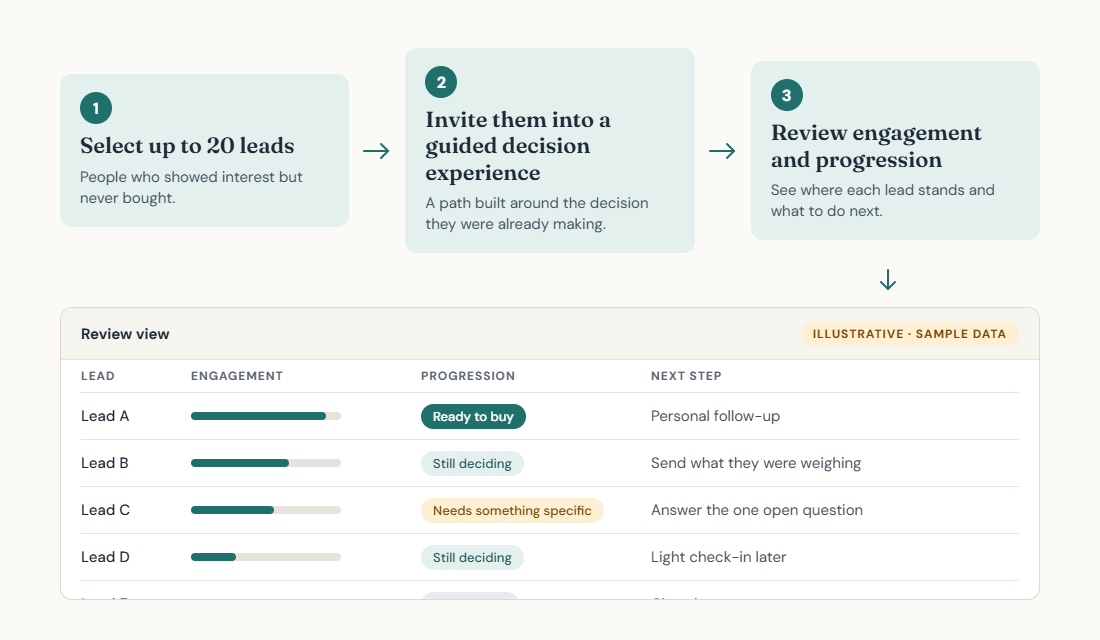
Free 20 Lead Revival Pilot — For San Diego-Area Businesses
See who engages, how participating leads progress, and what your team can learn from the pilot.
What if some of those leads haven’t made a final decision?
What if they still need information, have unresolved concerns, are weighing alternatives, or simply haven’t decided whether making a change is worth it?
Clear Path Studio is offering selected local businesses an opportunity to find out.
Customer indecision is costing your organization time and money.
These customers will often go through
the entire sales process — consuming valuable seller time and organizational resources,
perhaps even engaging in extended pilots or proof-of-concept trials — only to end up not
crossing the finish line.
It is better to receive a “No” than a “Maybe”.
Create Your Initial Dead Lead Revival Assessment and Opportunity Report
Complete the three interactive assessments below to understand your company’s current dead-lead situation, evaluate a possible solution, and estimate the preliminary financial opportunity.
Each assessment ends with a personalized summary and a Copy button. Copy each summary into a Microsoft Word document in the order shown.
- Current Situation and Preliminary Findings — Your current practices, information gaps, and areas requiring investigation.
- Proposed Solution and Pilot Evaluation — How customer decision information could help and what your company wants to learn.
- Preliminary Financial Opportunity — Your financial assumptions, resource costs, and illustrative recovery scenarios.
Together, these summaries form an initial business assessment that can be reviewed, revised, and used to evaluate participation in the Free 20 program.
This is a preliminary, self-reported assessment, not a verified diagnosis or financial forecast.
Introducing the Free 20 Lead Revival Pilot
Up to 20 previously unconverted leads · No Clear Path program fee within the agreed scope · No obligation to expand.
Does your organization currently have an Unconverted/Dead Lead program?
If you do this can be a compliment to your current system. Instead of simply sending another sales message asking whether someone is ready to buy, Clear Path provides a structured experience that helps the person work through their own decision.
If you do not have an existing program, this can be a good start, providing a framework for low cost, time efficient way to begin to manage your lead list.
As participants engage, your business gains information that a traditional CRM often cannot provide about where they are in their decision making process.
You can begin to understand:
- Who responds to the invitation.
- Who begins working through their decision.
- How far each person progresses.
- Where participants stop or appear to need additional clarity.
- Who indicates they are not ready yet.
- Who decides not to continue.
- Who reaches Purchase Ready.
- Who responds to your company’s recovery offer.
- Who ultimately becomes a customer.
The purpose is not to pressure 20 people into making a purchase.
The purpose is to learn where those leads are in their decision-making process and what are the best next steps to help them make a decision.
Your CRM Tracks Activity.
Clear Path Adds Decision-Making Insight Through Actionable Customer Intelligence.
Most customer relationship management systems are very good at recording activities.
But activity alone does not necessarily tell you whether a person is ready to make a decision.
Someone who has received;
six follow-up emails may still be uncertain about the problem, the available solutions, the value of an offer, or the tradeoffs involved.
Clear Path complements your existing CRM by adding another layer of information: customer decision progression.
Instead of relying only on contact history to estimate readiness, your business can observe how participants engage with the stages of their decision.
This can help your team identify more relevant follow-up actions without replacing the CRM you already use.
How the Customer Progression Path Works
In their article Stop Losing Sales to Customer Indecision, Matthew Dixon and Ted McKenna provide real world examples of how customers struggle to make decisions to buy. To understand the impact of the Clear Path Customer Progression, it helps to know about decision-making as a behavior of the brain. If real estate is about location, location, location, then decision-making is all about tradeoffs, tradeoffs, tradeoffs. There is no such thing as a perfect product or service solution for everyone because of the differences in persons situations and what they value. The brain uses tradeoffs to determine what solution is best given the unique context of the individual or group.
Before the brain can commit to buying, staying, or returning, it needs to have an adequate understanding of what is likely to happen, what is being giving up, what is being delayed. It is the behavior of making tradeoffs that is the key to a customer saying yes or no. That’s better than a maybe that continues to delay the decision and consume valuable company resources.
The brain must perform multiple steps prior to reaching this critical stage of decision making in order to be ready to decide.
1. Recognize the Need — First Thought
Is something happening in my life or business that deserves attention?
2. Understand the Problem — Problem Aware
What is the real problem I am trying to solve, and how important is it?
3. Explore Solutions — Solution Aware
What approaches are available, and how might they address my situation?
4. Compare and Evaluate — Deciding
Which considerations matter most to me? What benefits, costs, risks, and compromises am I willing to accept?
If these steps are missing or incomplete, the decision maker will stop and become stuck. They will either delay making a decision or will default to continuing to use the current product or service. Even when its clear the current solution is no longer working, until they have made their tradeoffs they will find it very difficult to commit.
Only after these are complete will the decision maker be ready to proceed through the next steps:
5. Reach a Decision — Decision Summary
Am I ready to continue, do I need more time, or have I decided not to proceed?
6. Take the Next Step — Purchase Ready
If I decide to move forward, what is the appropriate next step? Is there an offer available from the company?
When you know where they are stuck in the decision making process, you can provide them with the necessary experiences to move forward towards buying.
Participants can engage at their own pace and choose the level of information and interaction that suits them.
This becomes a crucial customer intelligence layer that complements the activity information in the CRM.
Clear Path Studios gives people a clearer way to make their own decisions.
Why Start With Previously Unconverted Leads?
We recommend beginning with leads your company has already stopped actively pursuing. Low Risk and High Reward
These are people who previously expressed interest but are no longer part of your active sales follow-up.
Start with leads the company has already stopped actively pursuing, so the existing sales pipeline is not put at risk.
This provides a practical way to evaluate Clear Path before considering its use with current sales opportunities.
What are the tradeoffs for your organization?
The pilot still requires thoughtful participation. Your business must consider staff time, appropriate communication practices, customer preferences, and any discount it chooses to offer.
But you are not being asked to change how your sales team manages its most promising active leads.
Instead, you can begin with a small, carefully selected group and ask:
Can Clear Path uncover useful information or opportunities among leads we’ve already given up on?
What Your Business Will Do
A manageable pilot involving up to 20 leads.
Step 1 — Create your Free 20 Pilot Project
Set up your company project and identify the products or services involved.
Step 2 — Identify up to 20 dead leads
Select people who previously showed genuine interest but never became customers and whom your company is no longer actively pursuing.
Step 3 — Prepare your Customer Progression Path
Working with Clear Path, develop a company-specific BUY Customer Progression Path that helps participants evaluate their situation and your offering.
Step 4 — Prepare the Situation Clarification questions
Help participants determine whether their current situation matches the problem your company can solve.
Step 5 — Select an optional recovery offer
Choose an appropriate coupon or incentive that may be presented to participants who reach Purchase Ready.
Step 6 — Invite your selected leads
Use an appropriate, permission-based invitation to offer participants access to their Customer Progression. Instead of “Are you still interested?”, the invitation presents “Here is something relevant to the decision you appear to be working through”.
Step 7 — Monitor decision progression
See who responds, how far they progress, and what decisions they express. Use the information to determine whether any follow-up would be helpful.
Step 8 — Review your results
Evaluate what your company learned about these previously unconverted leads and whether Clear Path could provide value as part of your ongoing customer engagement process.

What Will You Learn?

The result is more than a list of people who purchased. It is actionable customer intelligence that promotes re-engagement and lead list prioritizing.
At the end of the pilot, your business can review the information collected from the participating leads.
You may discover that some people are still interested but need additional clarity.
Others may be comparing alternatives, concerned about risk, or waiting for a better time.
Some may be ready to consider an offer.
And others may make it clear that they are no longer interested.
Every clearly expressed decision can provide useful information.
Even when no purchase occurs, knowing that a lead has explicitly declined is different from simply assuming that a person who stopped responding is no longer interested.
The Clear Path Results Dashboard is designed to organize participation, progression, and decision evidence so your team can identify appropriate next actions.
It can also help distinguish leads who may benefit from additional assistance from those whose decisions should be respected.
What Does the Pilot Cost?
The Clear Path Free 20 Lead Revival Pilot is free for selected participating businesses.
There is no Clear Path program fee for participation within the agreed pilot scope.
Your company may still incur its own operational costs, such as staff time, communication expenses, or the cost of any discount it chooses to offer.
Participation does not guarantee renewed engagement, purchases, or recovered revenue.
Your company remains responsible for appropriate outreach, applicable consent requirements, opt-outs, and respectful communication with its contacts.
The pilot is designed to evaluate whether decision-progression information can help your business better understand previously unconverted leads.
Who Should Apply?
The Free 20 Lead Revival Pilot is designed for San Diego-area businesses that:
- Have a meaningful number of previously unconverted leads in their CRM or contact records.
- Have stopped actively pursuing at least some of those leads.
- Can appropriately and lawfully reconnect with a small selected group.
- Want to understand where potential customers are in their decision-making process.
- Are interested in learning whether decision-progression information can improve their sales follow-up.
Businesses offering services or products that require customers to evaluate alternatives, consider tradeoffs, or make meaningful purchasing decisions may be particularly well suited.
What Happens After the Pilot?
Start small. Learn what works. Then decide whether to expand.
The Free 20 Pilot is an introduction to the Clear Path approach.
If your business finds the information valuable, you can consider extending the same decision-progression approach to other customer relationships.
First — Previously Unconverted Leads
Better understand people who once expressed interest but never purchased.
Next — Active Leads
Help current prospects make progress toward a purchasing decision.
Then — Former Customers
Understand whether people who stopped buying might consider returning.
Finally — Current Customers
Better understand the decisions customers make about continuing their relationship with your business.
There is no obligation to expand after the free pilot.
You May Not Need More Leads Just Yet.
You may need a better understanding of the leads you already have.
Before investing more money in attracting new prospects, consider what you might learn from the people who have already expressed interest in your business.
Some may be gone for good.
Some may still be deciding.
And some may simply need a clearer path forward.
Let’s find out what your previously unconverted leads can tell you.
Apply for the Free 20 Lead Revival Pilot
We are inviting selected San Diego-area businesses to explore whether the program is a good match.
Start with our short, 60-second match questionnaire.
Participation is subject to eligibility, availability, and the agreed pilot scope. Applying does not guarantee acceptance or specific business results.
AI can give people answers. But answers alone don’t help people decide. Clear Path helps businesses understand what their customers need to move forward—so the right customers can choose them for the right reasons.